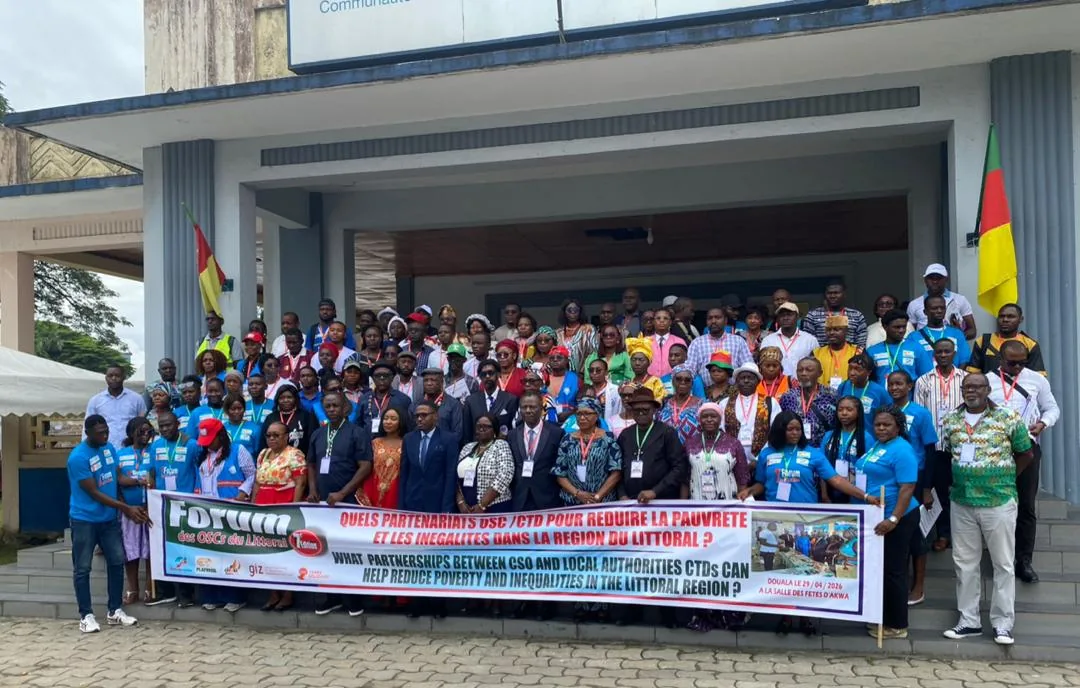
The Akwa banquet hall hosted on Wednesday, April 29, 2026, the seventh edition of the Forum of Civil Society Organizations of the Littoral, organized by PLAFOSCIL around a central question: what OSC-CTD partnerships to reduce poverty and inequalities in the Littoral region?
It was in a lively Akwa banquet hall that the Platform of Civil Society Organizations of the Littoral (PLAFOSCIL) brought together associative actors, local elected officials, technical and financial partners for the 7th edition of its annual forum. An event held under the high patronage of the governor of the Littoral region, and opened by his representative, Yvan Abena Afanda, head of the Police and Administrative Organization Division at the Regional Services of the Littoral.
Read more SYSTAC: Smooth interbank transfers in CEMAC despite technical incidents
The Littoral alone concentrates a large share of the contradictions of Cameroonian development: the country’s economic engine, the region nevertheless struggles to contain growing demographic pressures, persistent social exclusion, and territorial disparities that weaken its most vulnerable populations. The fundamental observation is shared: decentralization cannot produce its effects if the Decentralized Territorial Collectivities (CTD) operate in isolation. Civil Society Organizations (CSOs), through their proximity to grassroots communities, constitute an indispensable relay that local public authorities can no longer ignore. “CSOs, through their community anchoring, are the sentinels of the population’s needs. By working closely with town halls, we can ensure that no one is left behind,” said Kaptouom Marius, executive secretary of PLAFOSCIL.
Three panels, one common goal
The day was structured around three complementary thematic panels. The first questioned the conditions for strengthening participatory and multisectoral local governance, bringing together decentralization experts, representatives of CTDs and the MNDDEVEL. The second panel highlighted the concrete contribution of CSOs to the fight against poverty and social inequalities, with the participation notably of the association THE OKWELIANS and the association AS2D. The third, focused on social cohesion and sustainable local development, explored possible operational synergies between CTDs and CSOs at the Littoral scale, in the presence of representatives from MINEPAT and the NGO 1 Monde Avenir.
The afternoon was devoted to a World Café exercise led by Dr. Faty, allowing a pooling and collegial prioritization of recommendations arising from the exchanges, before their final presentation by the general moderator. The official closing was ensured by the coordinator of the PLAFOSCIL board of directors.
Read more The war against Iran has cost 25 billion dollars so far (Pentagon)
More than 54 CSOs mobilized
Beyond speeches, the forum mainly displayed significant associative mobilization: more than 54 civil society organizations engaged on the ground, alongside the mayors of Douala 1st, 2nd, 3rd and 5th, leading technical and financial partners — GIZ, European Union, Canada, embassies of the United States, France, Belgium and Switzerland — as well as representatives of administrative and traditional authorities. The reflections were deliberately aligned with Sustainable Development Goals 1 and 10, relating to the elimination of poverty and the reduction of inequalities. This forum aims to be more than a moment of dialogue: it seeks to lay the foundations for new social monitoring mechanisms and support for local public policies, for a measurable impact on the daily lives of the Littoral inhabitants.
Read more Fund mandates in CEMAC: more operations, but declining amounts