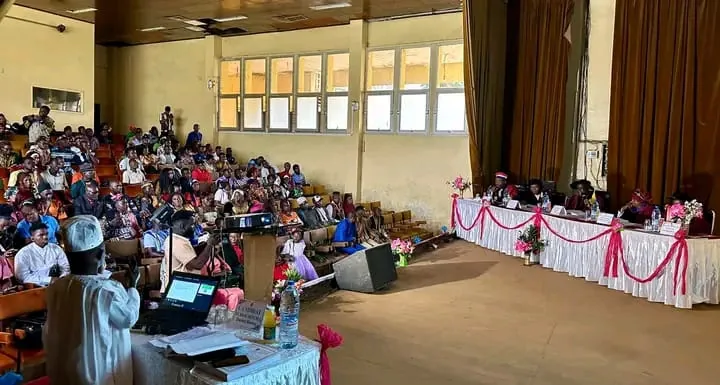
Faced with recurring power outages and the challenge of access to electricity in rural areas, a thesis defended at the University of Dschang opens up a new perspective. By focusing on wind energy and intelligent control systems, Dr. TCHOUMTCHA Daniel Borice proposes an approach that could transform the exploitation of renewable energies in Cameroon.
While Cameroon aims to increase the share of renewable energies in its energy mix by 2030, academic research provides concrete answers to one of the country’s main challenges: providing stable electricity, including in localities far from the national grid.
Defended on July 13, 2026, at the University of Dschang under the supervision of Prof. KENNE Godpromesse, Dr. TCHOUMTCHA Daniel Borice’s thesis stands out for its decidedly innovative character. Far from merely noting the sector’s difficulties, the researcher tackles the main obstacle to wind energy in Cameroon: the weakness of winds and the limitations of traditional control systems.
Its originality lies in the design of two advanced control strategies. Synergetic control and the higher-order Super-Twisting algorithm capable of optimizing the operation of autonomous wind installations. These technologies allow for extracting more energy, efficiently managing battery storage, and delivering a more stable power supply, even when wind or demand vary significantly.
Simulations carried out under Matlab/Simulink show superior performance compared to conventional regulators. The new controls significantly reduce electrical disturbances, improve the quality of the distributed current, and ensure better equipment stability, with a particular advantage for the Super-Twisting algorithm.
Beyond the scientific performance praised by the jury chaired by Prof. René TCHINDA, this work carries a strategic dimension for public policies. In a country where hydroelectricity still largely dominates production, it demonstrates that the wind potential, often considered insufficient, can become a real lever for electrification thanks to adapted control intelligence.
This research thus opens a credible path to accelerate access to clean energy in rural areas, reduce territorial inequalities, and support the national energy transition. A contribution that reminds us that technological innovation is now an essential link in Cameroon’s energy sovereignty.
Read more Female leadership: 19 civil society actresses now better equipped to take action
Read more A goal-fest in the final: Conor McGregor placed a $100,000 bet on the Planetary Tournament final