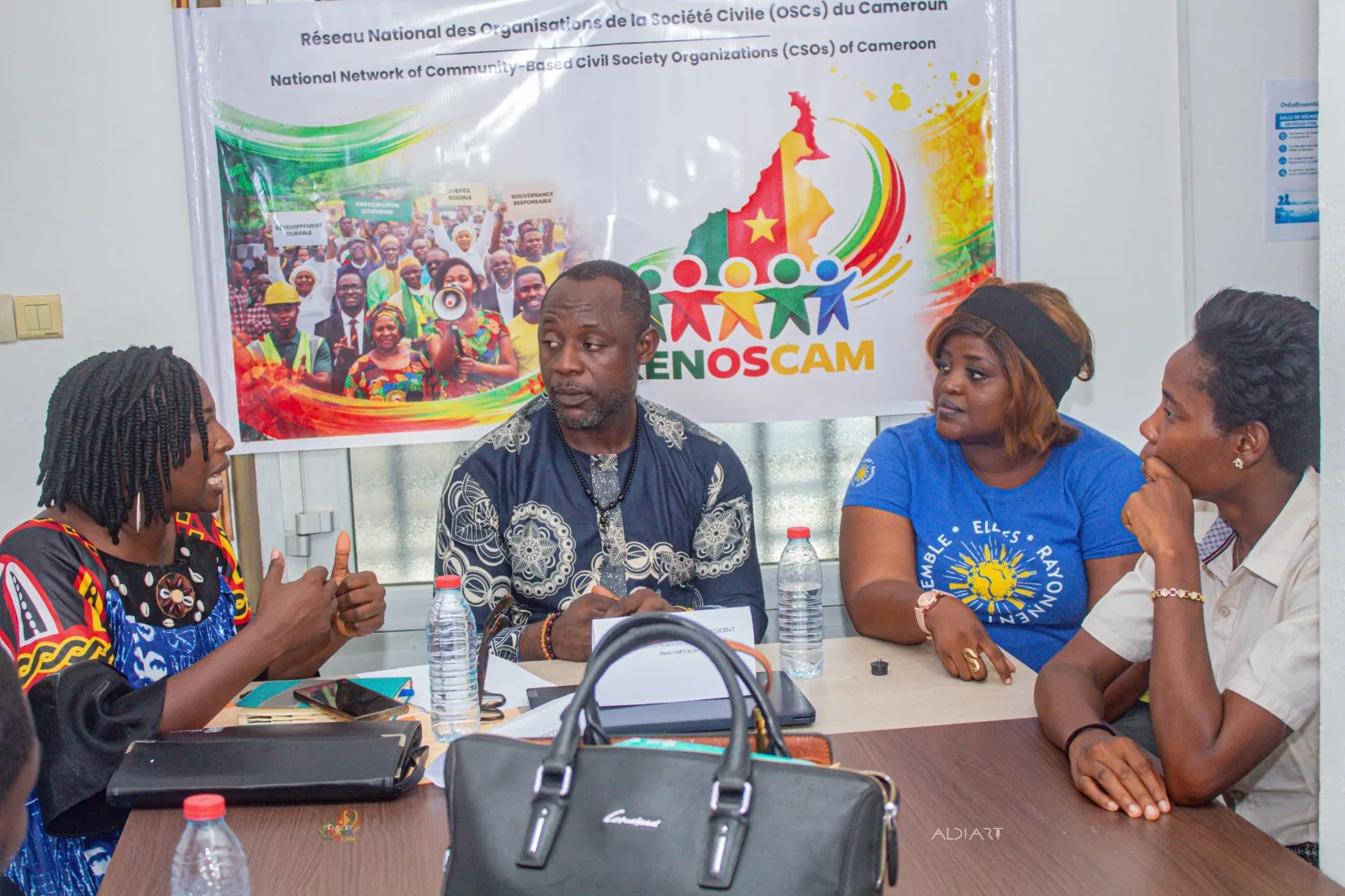
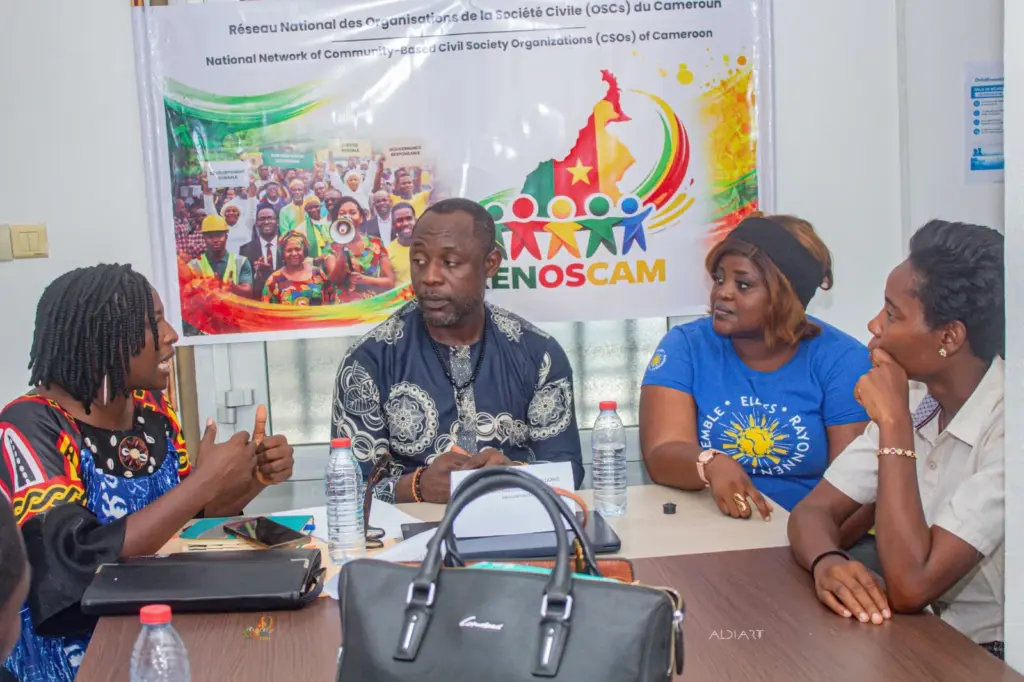
It was in Bépanda on Thursday, April 09, 2026, in the economic capital of Cameroon, that the National Network of Civil Society Organizations of Cameroon, RENOSCAM, was officially launched. A long-awaited birth, driven by a simple but powerful conviction: isolated voices do not carry.
Together, they can change things. Doris NGUM, national coordinator, Ivan Trésor MBOCK, Executive Secretary, and Marius KAPTOUOM, deputy national coordinator, led this launch with a clear message of unity. Their ambition: to build a national platform capable of federating civil society organizations (CSOs) around a shared vision — participatory governance, social justice, and sustainable development.
Read more Liquefied Natural Gas: Cameroon’s export revenues continue their decline in 2025
Above all, it is about filling a structural void
The birth of RENOSCAM responds to an observation that its founders do not hesitate to formulate bluntly. “Civil societies are often in a vertical practice and do not really do what they are supposed to do within communities, for lack of financial independence,” points out Doris NGUM. A well-known reality on the ground: committed organizations, led by dedicated volunteers, but fragmented, isolated, and too often constrained by a lack of resources.
RENOSCAM does not come to replace these structures. It intends to equip them, connect them, and allow them to weigh in collectively. “A single voice cannot be heard, but collective voices can be,” summarizes the national coordinator. This is precisely the niche the network intends to occupy.
A young country that calls for a young response
One of RENOSCAM’s central arguments is demography. Cameroon is a country where youth represents the bulk of the active population, and civil society is no exception to this reality: 70 % of its members are under 35 years. For Ivan Trésor MBOCK, this data imposes a new direction. “Having a country with 70 % youth imposes a new direction. RENOSCAM wants to work with development partners and the central state, because it is together that we will establish a proud and prosperous Cameroon where young people will no longer need to seek their future elsewhere.” CSOs deployed in the ten regions of the country, driven by these young people who are active every day on the ground — it is this dispersed energy that the network intends to channel and amplify.
Read more Cocoa: 18,7% increase in export revenues in 2025
Operationally, RENOSCAM relies on existing structures rather than starting from scratch. Marius KAPTOUOM, deputy national coordinator, details the approach: “We will rely on organizations already present in the different regions to mobilize and present the vitality of what we bring in terms of strategies, actions, and activities.” The idea is to pool what can be pooled, clarify initiatives carried out at the local level, and integrate them into a coherent national dynamic. The network also intends to dialogue with public institutions and technical and financial partners — not in a logic of confrontation, but in one of assumed collaboration at the service of communities.
RENOSCAM positions itself above all as a space. A space for dialogue, consultation, and collective action for a civil society that, until now, was moving in a fragmented manner. “Social transformation can never happen because a single person did something. When we come together, we can accomplish much more,” concludes Doris NGUM.
The challenge is as great as the ambitions displayed. But in Bépanda this April 09, 2026, something has been set in motion.
Read more Strategic partnerships: Mindef seals three major industrial agreements