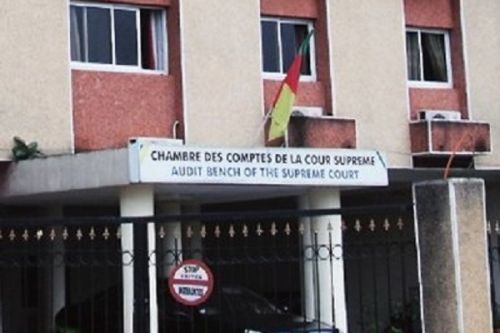
While the government reports a debt-to-GDP ratio below the CEMAC community ceiling, the Court of Auditors highlights a much more complex reality.
Behind the reassuring statistics lies an accumulation of arrears, off-balance sheet commitments, and poorly accounted for debts that cast serious doubt on the actual level of Cameroonian public debt.
Read also: Cameroon: Fayçal Hamadou Demaissala leaves PCRN
According to the Report on the Execution of the 2024 Finance Law, endorsed by the Cameroonian Court of Auditors in September 2025, the direct debt of the central administration amounts to 13,600 billion FCFA. This amount is up 15.4% compared to 2023, mainly driven by external borrowing, which now accounts for nearly two-thirds of the outstanding debt.
When the scope is extended to the entire public sector, the debt reaches 14,649 billion FCFA, or 45.6% of GDP. This ratio is showing a significant increase but remains below the CEMAC’s community threshold of 70%. Officially, therefore, Cameroon remains within the limits.
However, this reassuring reading is largely nuanced by the Court’s observations.
The first blind spot highlighted by the financial magistrates is the “Restes à Payer” (RAP), or outstanding payments. These are expenses incurred by the state, sometimes for several years, but not yet settled.
As of December 31, 2024, these RAPs amount to 926.5 billion FCFA, almost double their 2023 level. More concerning still, 739.4 billion FCFA come from previous fiscal years, some dating back to 2020.
The major problem is that these amounts are not included in the official public debt. They are classified as non-financial debt, which, according to the Court of Auditors, masks a substantial portion of the state’s actual indebtedness. The institution clearly recommends their reclassification as financial debt and their inclusion in the finance law.
Another source of uncertainty is the debt of public enterprises and establishments, as well as that of decentralized territorial communities (CTD).
An audit of unstructured debts for the period 2000-2019, published in August 2024, identified 671.7 billion FCFA in arrears (salary, commercial, fiscal). However, this exercise does not cover the years 2020 to 2024, nor all CTDs.
For the Court, the conclusion is clear: “the public sector debt situation as of December 31, 2024, remains partial.”
Beyond the visible debt, the Cameroonian state also carries significant contingent liabilities, particularly related to public-private partnerships (PPPs).
Their amount is estimated at 4,895 billion FCFA, or about 14.2% of GDP. As long as the projects proceed normally, these commitments remain outside the debt calculation. However, in case of default, they can quickly turn into firm debt, with a brutal impact on public finances.
In addition to this are the “Soldes Engagés Non Décaissés” (SEND’s), or committed but undisbursed balances: 4,102 billion FCFA in loans, mainly external, already contracted but not yet drawn.
Even if they do not yet finance any expenses, these amounts generate commitment fees and signal future pressure on indebtedness and debt servicing.
Read also: Volleyball: MINSEP reprimands Littoral governor
On a regional level, Cameroon respects the CEMAC’s debt-to-GDP criterion. However, it violates the criterion of non-accumulation of arrears due to the high volume of RAPs.
According to the IMF’s Debt Sustainability Framework, the situation is equally concerning: in 2024, only one out of five ratios is met. The debt service to own revenue ratio, at 18.7%, exceeds the alert threshold of 18%, reflecting an already heavy burden on the state budget.
Worse still, debt service execution only reached 58.4%, with a very low rate for domestic debt. This underpayment mechanically fuels the accumulation of arrears.
Ultimately, while Cameroon’s official debt is reported at 45.6% of GDP, the Court of Auditors clearly warns against a significant underestimation of the real indebtedness.
The non-consolidation of nearly 1,000 billion FCFA in outstanding payments, the incomplete accounting of debts of public entities, and the scale of off-balance sheet commitments obscure the reading of public finances.
Behind the controlled figures, Cameroonian debt appears heavier, more diffuse, and riskier than it seems. A finding that reopens the debate on budgetary transparency and the real sustainability of the country’s debt trajectory.
Read also: Mercato: Emmanuel Moungam signs with Landskronabois