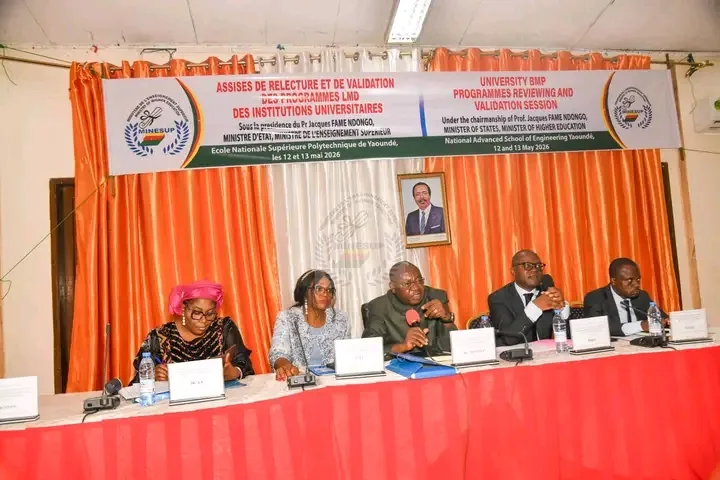
Gathered in Yaoundé since May 12, 2026, the academic leaders of state universities are working on the review and harmonization of the curricula of professional programs in traditional faculties. A reform presented as decisive to strengthen student mobility and improve graduate employability.
Read more Africa Forward: Guterres calls for a re-foundation of the partnership with Africa
The work of the second phase of the meetings dedicated to the review and validation of the curricula of professional programs in the traditional faculties of state universities continues at the National Advanced Polytechnic School of the University of Yaoundé I. The opening ceremony, chaired on Tuesday by Prof. Wilfred Nyongbet Gabsa, Secretary General of the Ministry of Higher Education (MINESUP), brought together deans and heads of departments of the Faculties of Arts, Letters and Human Sciences (FALSH) as well as the Faculties of Educational Sciences (FSE).
At the heart of the discussions: the harmonization of training frameworks in accordance with the requirements of the License-Master-Doctorate (LMD) system. For academic authorities, the disparities observed between universities now hinder student mobility and complicate the mutual recognition of credits.
Read more Regional transit: N’Djamena restarts the Cameroon-Chad-CAR corridor project
In his speech, the representative of the Minister of State, Minister of Higher Education, recalled that the LMD system remains an essential lever for the modernization and professionalization of teaching. Presenting the technical framework of the work, Prof. Alphonse Tonye, Director of Higher Education Development, emphasized the desire to build a common training foundation integrating professional skills, learning achievements, and harmonized evaluation standards.
The meetings, which conclude on May 13, 2026, should result in model curricula aimed at strengthening the coherence of university pathways and the competitiveness of Cameroonian higher education.
Read more FEICOM: focus on more effective mobilization of local resources