Between rumors of strikes and misunderstandings regarding app commissions, a sense of tension has taken hold of the VTC sector.
For several weeks, the streets and social media circles of Cameroon’s major cities have been buzzing with a single subject: the taxation of income generated by digital mobility platforms. Between rumors of strikes and misunderstandings regarding app commissions, a sense of tension has taken hold of the VTC sector. However, behind the headlines lies a specific tax mechanism that, once stripped of speculation, reveals a structured change in the functioning of Cameroon’s digital economy.
Read also: International Women’s Day 2026: official launch in Nkoteng on 20 February 2026
To navigate this transition, it is essential to move beyond the ambient noise and focus on the facts. The measure currently sparking reactions is not a private tax, nor a sudden whim of digital platforms. It is a government-mandated tax policy designed to formalize a sector that has become an essential part of the national economy. The taxation of income generated via digital platforms was first introduced by the Cameroonian government in the 2024 Finance Law. At that time, the State had established the principle that individuals earning income through digital interfaces, whether in transport, services, or commerce, should contribute to the Public Treasury. The only pitfall was in the collection of these funds, a situation that the 2026 Finance Law clarifies, adjusts, and implements after consultations and adjustment by the government.
Understanding the 1 % rate
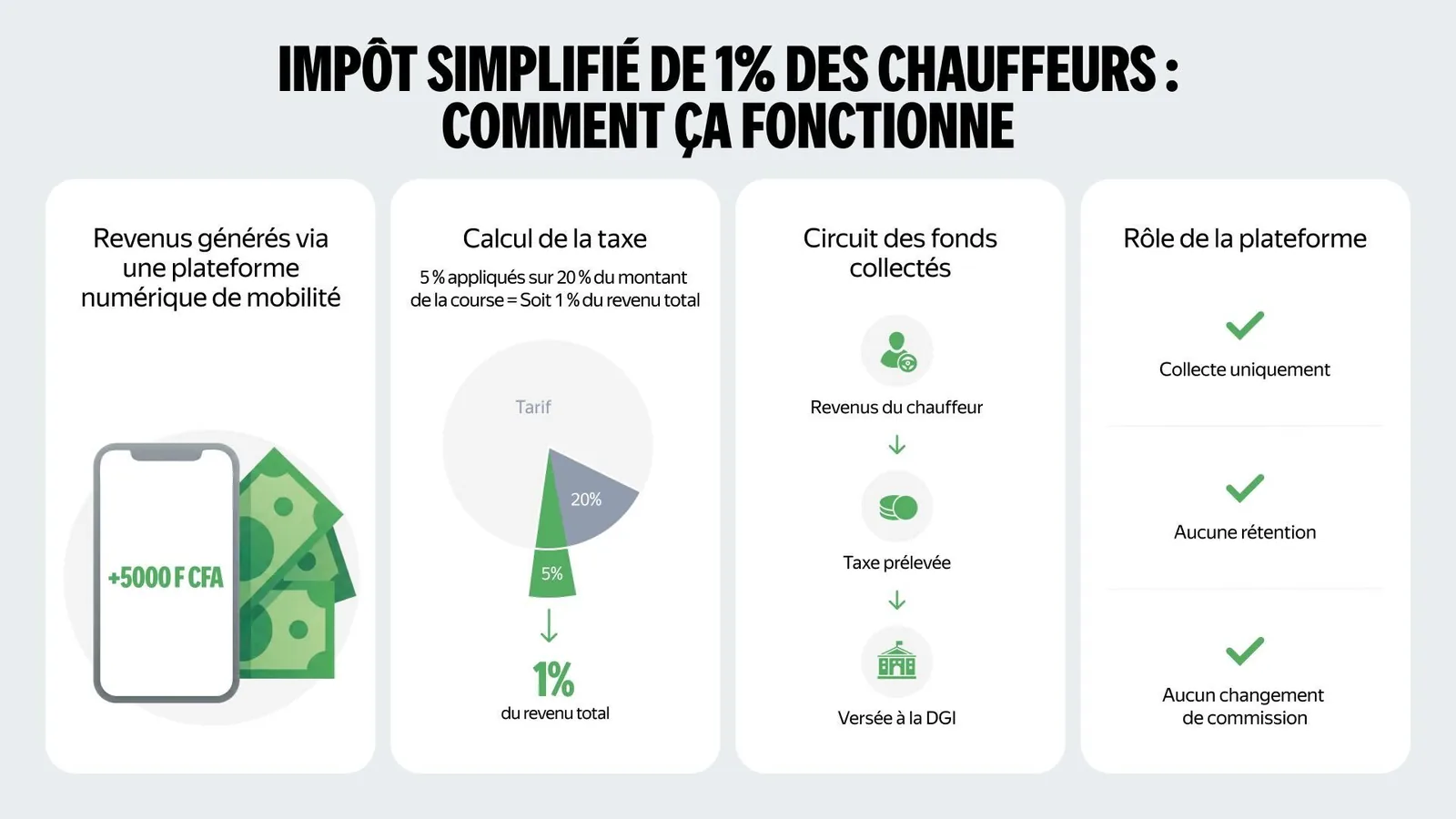
For many drivers, the main concern is the impact on their daily net income. The tax authorities (DGI) have opted for a simplified approach to keep the tax burden manageable for independent workers. The calculation of this tax follows a two-step logic: first, a taxable portion of 20 % is applied to the gross amount generated per trip, then a 5 % tax is applied on this specific 20 % base. This reflects an effective tax rate of approximately 1 % of the total gross income received by the driver. For example, for a trip totaling 2 000 FCFA, the tax would amount to approximately 20 FCFA. This simplified system was designed to reflect the often low margins in the transport sector while ensuring that digital workers are integrated into the official tax system.
It should be noted that platforms such as Yango, Gozem or other mobility apps operating in Cameroon are not the beneficiaries of this money; they are merely collection agents designated by the General Directorate of Taxation (DGI). This means there is no increase in service fees or commissions; the entirety of the tax collected is transferred directly to the DGI. By deducting the tax at the source, the system spares individual drivers the administrative burden of filing complex monthly tax returns themselves.
This role is part of a broader international trend where tax authorities leverage digital intermediaries to streamline revenue collection in the gig economy. It ensures that the tax is collected transparently and reaches the state coffers without any portion being lost along the way. It would be wrong to view this as a measure targeting a specific company. This tax concerns the entire ecosystem. It applies to all digital mobility platforms operating on national territory and to all independent drivers using these platforms to generate income.
Read also: Port of Douala: partial suspension of scanner inspection operations entrusted to Transatlantic
The DGI’s objective is to ensure “tax fairness.” In a traditional taxi or transport business, operators are subject to various local and national taxes. By implementing this 1% measure, the government ensures that the digital transport sector, which has seen exponential growth over the last five years, operates on an equal footing with traditional sectors.
Towards a more peaceful dialogue
Transitions in tax policy rarely happen without friction, especially in a sensitive social climate. However, much of the current frustration stems from the belief that platforms are unilaterally increasing their prices or that a “new” burden has been abruptly imposed on the sector.
The reality is one of formalization. As Cameroon’s digital economy matures, it must move from a “gray area” to a structured framework. By understanding that this is a state-led initiative, that the rate is set at a manageable 1 %, and that platforms are merely channels for the DGI, the public debate can shift from speculation to informed adaptation.
As these measures become operational, the focus remains on maintaining the digital economy as a source of opportunity for thousands of Cameroonians while contributing fairly to the nation’s development.
Read also: Cameroon: Consty Eka is dead, Africa pays tribute to him