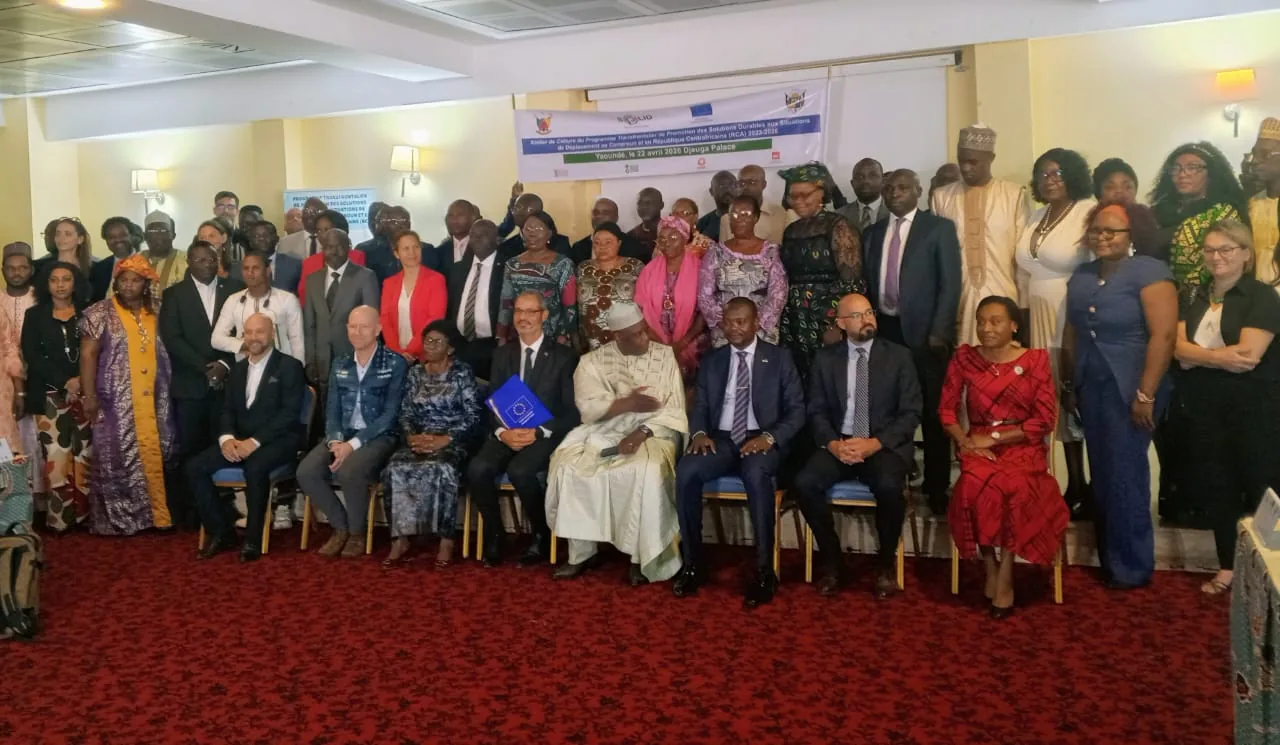
Implemented since January 2023, the first phase of the program funded by the European Union is coming to an end. A closing workshop brings together the various stakeholders this April 22, 2026, in Yaoundé.
Three years after the start of the implementation of the cross-border program for the promotion of sustainable solutions to displacement situations in Cameroon and the Central African Republic (SOLID), it is time for an assessment. Central, regional administrative, local authorities, state institutions, financial and institutional partners, as well as communities from Cameroon and the CAR are gathered in Yaoundé. During the closing workshop of the said program, they present achievements, share lessons learned, and project future actions.
Read more Foreign trade: the deficit shrinks despite a marked decline in imports
Indeed, over the last three years, the program defined following the Yaoundé declaration of June 19, 2022, has covered 39 communes in the Cameroon-Central African Republic border zone. 19 communes in the Equateur and Yade regions in the CAR and 10 communes in the East and Adamaoua regions in Cameroon have benefited from the program’s advantages. Implemented by the NGOs Danish Refugee Council (DRC), Action Against Hunger (ACF), Care International in Cameroon, and the Norwegian Refugee Council (NRC) in Cameroon and the CAR, the program has improved the living conditions of nearly 180,000 people through concrete, innovative, and sustainable initiatives.
Funded by the European Union to the tune of 12.5 billion FCFA over 42 months, the program aimed to promote sustainable and inclusive solutions for refugee and host populations in the border areas of Cameroon and the CAR. A zone where the persistent crisis in the CAR has led to a massive influx of people into Cameroon since 2013. Until 2025, collected data indicate the presence of nearly 251,000 Central African refugees in Cameroon, exerting increased pressure on public resources and infrastructure.
Fruits of the SOLID program
To alleviate the impact linked to this reality, SOLID has strengthened access to basic social services for both refugees and local populations, facilitated socio-economic integration through support for income-generating activities, and facilitated exchanges between cross-border regions,” declared the Minister of Agriculture and Rural Development Gabriel Mbairobe, representing the Minister of External Relations. Other spin-offs of this initiative include ”the production of civil documentation including birth certificates, the construction of facilities for drinking water supply, support in health centers in remote areas, and the training of people on civilian protection,” confided the leader of the SOLID consortium, Benoit COUTURIER.
All these achievements are the source of satisfaction for the Central African government. Because the SOLID program is executed ”in the right direction, in line with the recommendations of the Cameroonian and Central African authorities. It is part of the implementation of the decentralization policies of both countries,” declared Mesmin Guenguebe Mbari. The advisor to the Prime Minister of the CAR would like phase 2 of the program to see strong involvement from local authorities.
Active solidarity in a complex global context
The European Union, which funds the program, wanted to highlight Cameroon’s capacity to host refugees on its soil. The organization ”has worked with international and national NGOs to provide support to refugees and commends the solidarity of host communities and government actors who are mobilizing in an increasingly complex global context,” said Philippe LAFOSSE, Deputy Head of the European Union Delegation to Cameroon.
In the same vein, the Minister of Agriculture, in opening the workshop, specified that it is not only a moment to take stock of the program, but ”a moment for strategic reflection.” This assessment is not an end in itself, but ”an anchor point for the displacement of populations.” For him, the issue of refugees is not limited to improving their living conditions. ”Beyond suffering, it is a question of regional security. By working hand in hand with the Central African Republic, we find that borders are not barriers, but doors for global openness,” he indicated. It will therefore be necessary for the upcoming phase 2 to sustain the achievements and learn lessons from the shortcomings.
Read more Global demand: exports support growth, consumption remains cautious