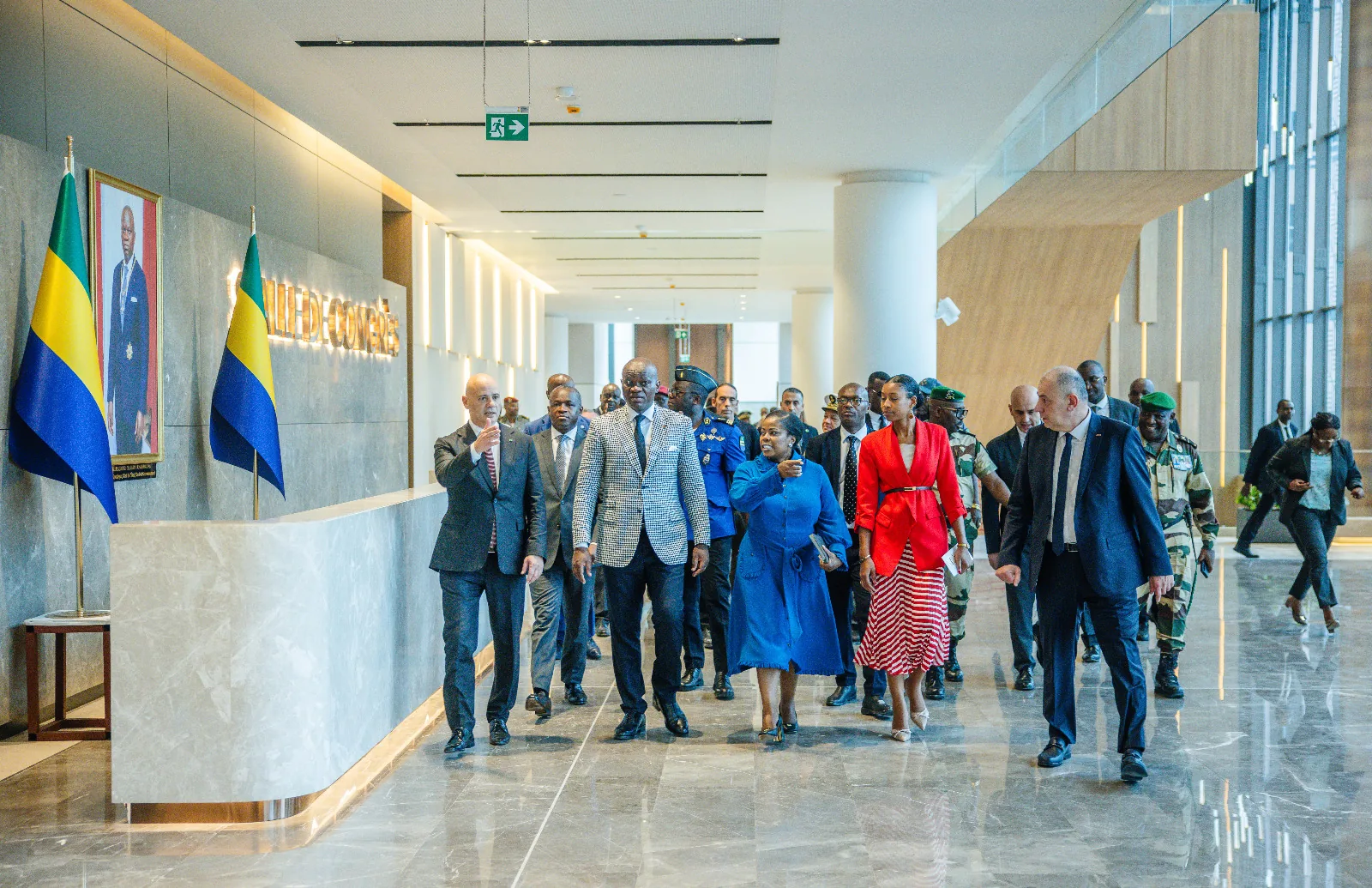
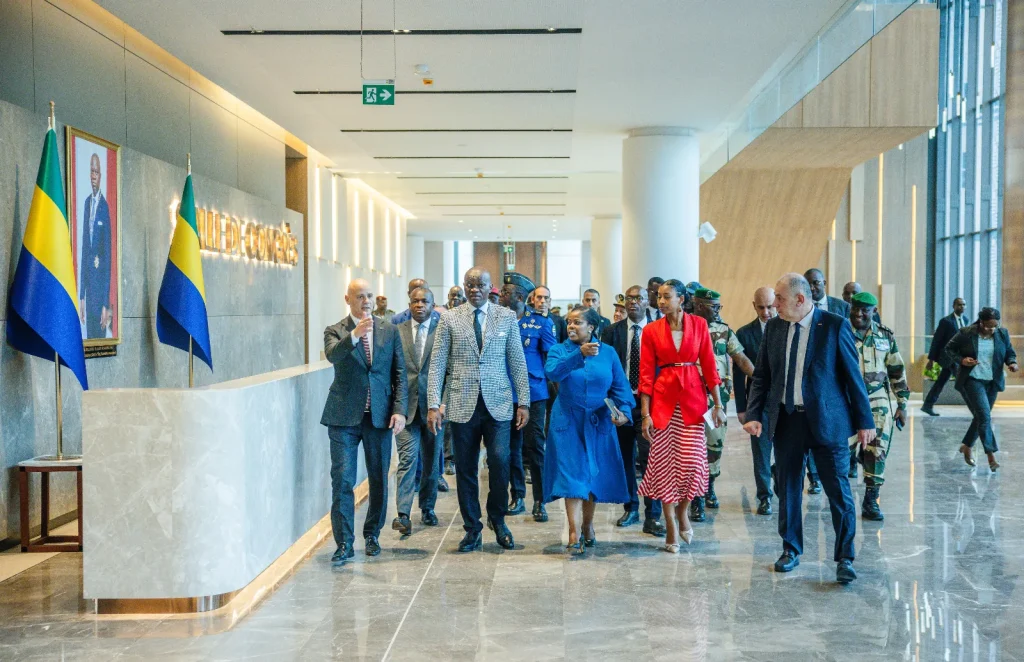
The construction site of the new Palais des Congrès in Libreville is entering its final phase, and the President of the Republic, Brice Clotaire Oligui Nguema, is personally monitoring the progress of the work. Since the beginning of March, he has visited the site several times, where he is welcomed by Nina Abouna, General Commissioner for Exhibitions, as well as Selim Bora, President of the Summa Group, the company in charge of construction. These repeated visits testify to the strategic importance given to this project, which goes far beyond the simple delivery of modern infrastructure.
Read more Public debt: Cameroon will pay twice as much to repay than to train its youth in 2026
Because the choice of location is not insignificant. The Palais des Congrès stands on the former site of the Cité de la Démocratie, a space deeply inscribed in the country’s political memory. It was there that some of the most significant moments in Gabon’s contemporary history took place, notably the 1990 National Conference, which opened a new institutional era. The gradual disappearance of the buildings over the years had left a void, almost a symbolic wound, as if an essential chapter of national life had closed without being replaced. By deciding to rebuild at this precise location, the Head of State is choosing an assumed continuity: giving life back to a place where the country learned to debate, to transform itself, and to project itself into the future.
But this rebirth is not only memorial. It is part of a much broader vision: that of making Libreville a true crossroads for major international meetings. The future Palais des Congrès, designed according to international standards, is intended to become the central tool of an ambitious attractiveness strategy. With its 3000-seat auditorium, its modular spaces, its cutting-edge technological equipment, and its capacity to host high-level summits, the infrastructure is designed to reposition Gabon on the map of destinations capable of hosting large-scale diplomatic, economic, and institutional conferences.
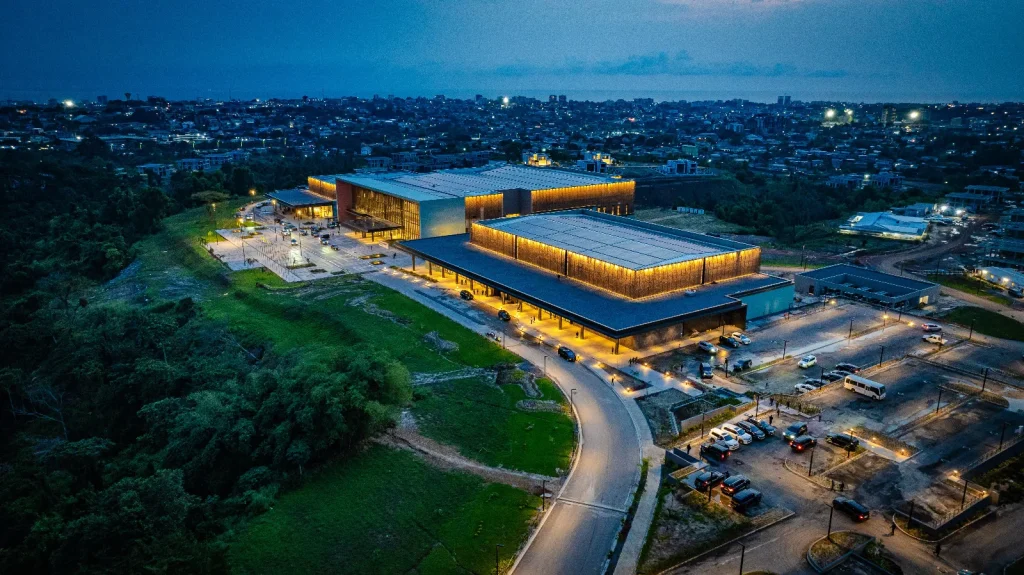
This orientation responds to a clearly expressed desire by the Head of State: to develop the MICE (Meetings, Incentives, Conferences and Exhibitions) sector as a lever for influence and growth. In a region where few countries have infrastructure of this scale, Libreville intends to distinguish itself and capture a portion of the major international events that shape the continent’s political and economic dynamics. The Palais des Congrès thus becomes the cornerstone of a soft power strategy, intended to strengthen Gabon’s influence and diversify its economy.
The General Commissariat for Exhibitions of Gabon (CGEG), led by Nina Abouna, will play a decisive role in this transformation. Its mission will be to structure the national event offering, professionalize the reception of delegations, and build a true MICE industry capable of sustainably attracting international meetings. The inauguration of the Palace, scheduled for early May in the presence of several heads of state, will mark the official launch of this new ambition.
Through this project, Gabon is not just rebuilding a building: it is reactivating a symbol, asserting a vision, and preparing for the future. Libreville now aspires to once again become a place where people meet, where they dialogue, where they decide and take note of the realization of strategic partnerships. A crossroads, in the full sense of the term.
Read more Cameroon-Douala: Cabral Libii’s lawyer files a complaint against Jacques Bertrand Mang