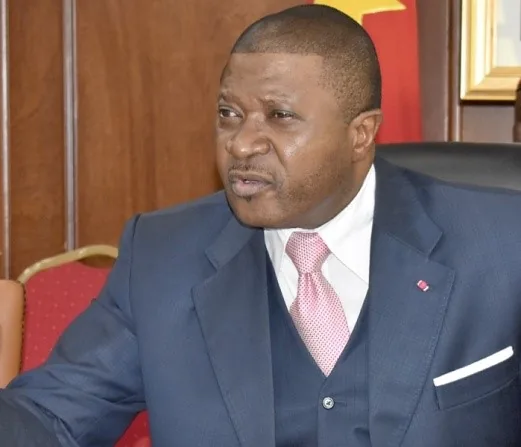
The government and the road freight transport unions met until late last night, on the eve of a planned strike in the sector. The resolutions taken have eased tensions in favor of continuing activities on the roads.
Professionals in the road transport sector have decided to lift the strike order scheduled to begin in the road freight transport sector on August 24, 2026. Platform members are going about their activities. The government defused the strike last night after a long meeting.
Read more Cameroon: Deactivation of uncleared phones from September 1, 2026
Presided over by the Minister of Transport, Ernest Massena Ngalle Bibehe, the meeting saw the presence of the Minister of Labor and Social Security, the Minister of Commerce, union leaders, representatives from the Ministry of Finance, the Ministry of Forests and Wildlife, the national gendarmerie, the national police, the National Shippers Council of Cameroon, as well as the Land Freight Management Office.
Resolutions following the dialogue
The dialogue between the government, unions, and other stakeholders resulted in the adoption of 13 resolutions to address union demands.
The parties agreed to suspend the issuance of the S6 license until further notice and suggest the establishment of an interministerial committee within the Prime Minister’s Services to review decree no. 2022/8801/PM of October 10, 2022, on road freight transport for own account. They agreed to forward concerns regarding the applicability of decree no. 2025/314 of July 16, 2025, concerning the transformation of the CNCC to the Prime Minister’s Services and suggest setting up an interministerial committee to examine these concerns.
Furthermore, they decided that road checks on goods in transit will be carried out exclusively at the four conventional checkpoints of the Douala-N’Djamena corridor and the three conventional checkpoints of the Douala-Bangui corridor. It is now forbidden for road prevention teams of the Ministry of Transport to collect flat-rate fines. The parties decided to forward the follow-up on the decree extending the national collective agreement of the road transport sector to the Primary Services within 24 hours. And to establish a consultation framework between the National Petroleum Deposits Company (SCDP), the Autonomous Port of Douala, the Autonomous Port of Kribi, and the drivers’ trade unions.
Read more Cameroon: towards a modern financial center by 2030
Similarly, the Minister of Commerce instructed the SCDP to apply the order of February 13, 2024, setting the procedures for loading and unloading tanker trucks in petroleum depots within 24 hours. The same minister took measures to stop weighing tanker trucks at weighing stations.
Administrative authorities and law enforcement must take into account concerns related to road harassment suffered by transporters in the North-West and South-West regions.
Other resolutions concern the suspension of mobile axle weighings on the Édéa-Kribi axis; size checks which must be carried out exclusively at weighing stations where all administrations are represented; the review of the CNCC note on import and export fees in the East region. The Minister of Transport takes note of a clarification on the control methods of flatbeds and sideboards. A list of critical points on the poor condition of roads will be sent within 24 hours to public authorities for rehabilitation as soon as possible.
The meeting, which started Sunday at 1 p.m., ended past midnight on Monday. Speaking on Crtv this morning, El Hadj Oumarou, general coordinator of the Land Freight Management Office, said, “this is one of the rare times we hold a meeting that takes quite some time.” He reassures that all drivers are informed of the easing. Praising the measures taken, notably the reduction of checkpoints on the corridors, he welcomes the success of the dialogue and the commitment of all parties to improve working conditions and strengthen road safety.
Read more MINEPIA – MAETUR: a partnership to secure pastoral and fishing land tenure