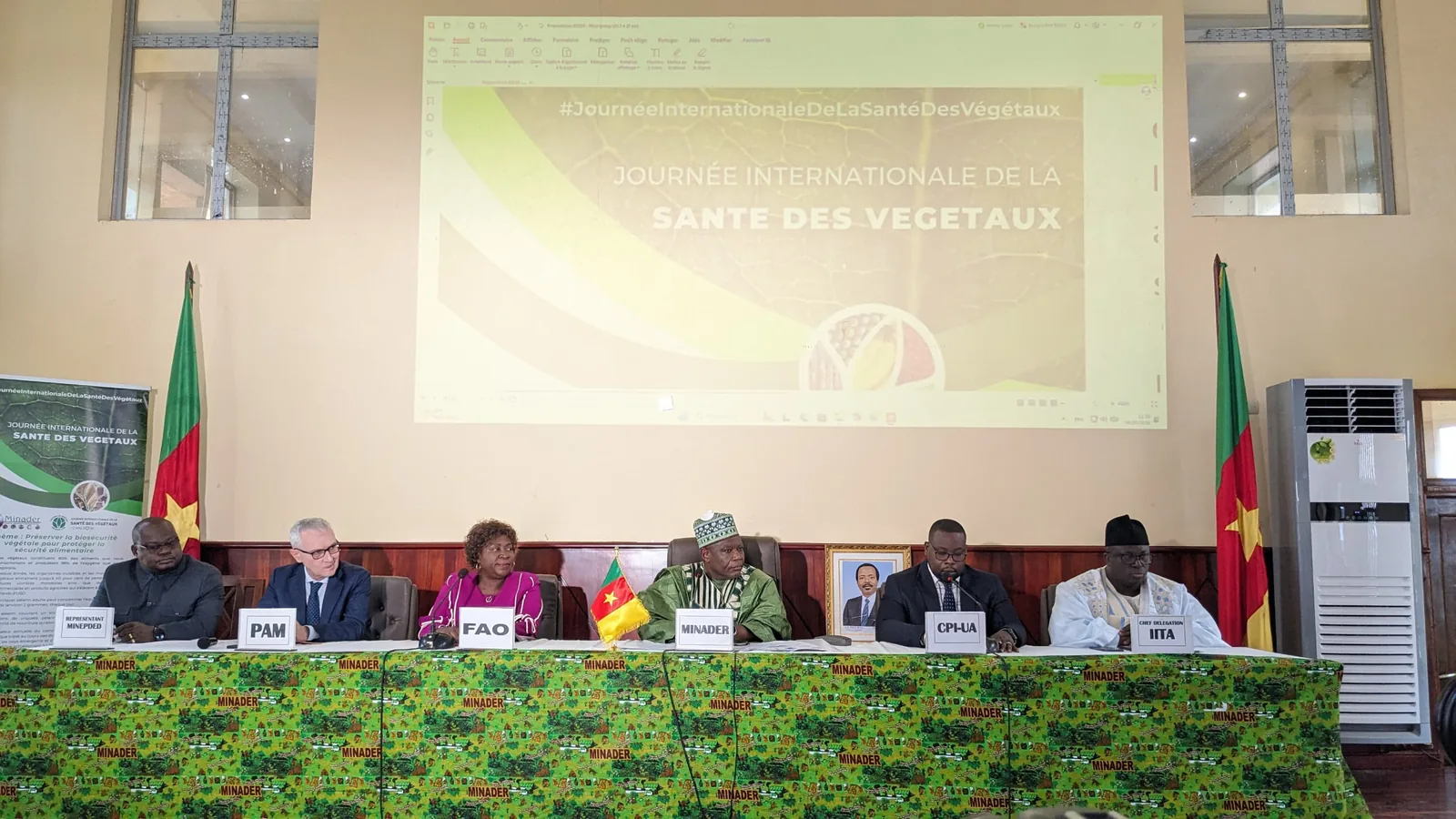
In the lead-up to the International Day of Plant Health, stakeholders gathered in Yaoundé on May 8 to discuss biosafety and food security, strategic levers against hunger and poverty.
May 12, 2026 marks the 5th edition of the International Day of Plant Health. A day aimed at raising awareness within the international community about protecting plant health. In preparation, the Ministry of Agriculture and Rural Development (Minader), in collaboration with its public and private partners, civil society, and the United Nations System, organized a roundtable. The various parties began to dissect the theme chosen for this year, namely: “plant biosafety in the service of food security.”
Read more Environmental Cooperation: Yaoundé and the UN Align Their Priorities Ahead of Major COPs
Addressing the challenges of biodiversity in Cameroon, Gabriel Mbaïrobe, Minister of Agriculture and Rural Development, links food security to the performance of the agricultural sector. Furthermore, he regrets that productivity is constantly threatened by pests and plant diseases, risks related to the introduction of harmful organisms, and the growing impact of climate change. It is in this context that he advocates for plant biosafety which, according to him, is the solution to secure crops and ensure sustainable agricultural production.
The minister lists the three pillars highlighted by his department to solve the problem. He first cites prevention and control at the borders, then quarantine measures and risk analysis. In the preventive case, the ministry intervenes upstream to prevent the introduction of harmful organisms. “It deploys a rigorous territorial network thanks to its network of 52 phytosanitary police posts installed at the borders.” The second point, quarantine, consists of isolating or banning certain products to stop any spread within the territory. Finally, before any importation of plants or seeds, phytosanitary risk analyses are systematically conducted to assess and neutralize potential threats.
Seed as a double-edged sword
In his speech, Dr. Komi K. Kouma, representative of the International Institute of Tropical Agriculture (IITA), emphasizes that seed is not just a simple input, but the starting point of health security and agricultural productivity. In his speech, he suggests that seed can be a “Trojan horse” for pathogens. Faced with threats, seed is also the solution thanks to varietal improvement. He advocates for a balanced vision between economy, health, and environment.
Read more Children’s Rights: the UN calls on the Cameroonian Parliament
Dr. Komi K. Kouma explains that an infected seed not only compromises the planter’s harvest but can contaminate neighboring fields and entire areas. For him, control during national and international exchanges is crucial to avoid the introduction of scourges that are difficult to eradicate, such as maize lethal necrosis disease (MLMP) in East Africa or banana bunchy top virus (BBT) at the Cameroonian border.
The representative of the United Nations Food and Agriculture Organization (FAO) mentioned the challenges related to globalization and climate, which require continuous strengthening of technical, human, and financial resources to ensure sustainable resilience. For her, any new seed variety must be certified non-GMO by an accredited body and subjected to border sampling for laboratory analysis. She calls for strict measures to prevent the introduction of absent but dangerous pathogens, such as cassava brown streak disease, Fusarium TR4 (banana), or lethal necrosis of maize.
The roundtable ended with a conclusion delivered by Minader: “Preventing biodiversity loss, food security is everyone’s business.”
Read more Cameroon: Yaya Saidou Maïdadi is no more