More than 450,000 children at risk of malnutrition in South Sudan (UNICEF)

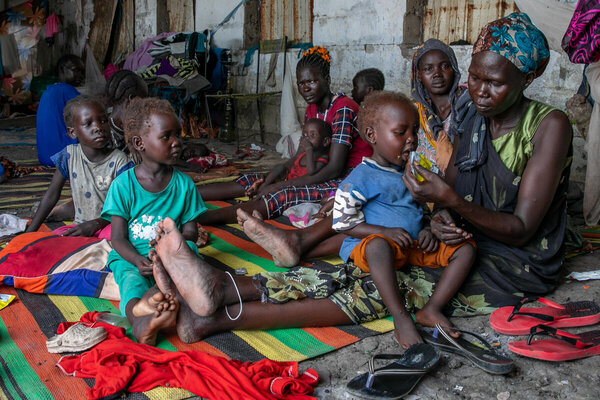
More than 450,000 children at risk of malnutrition in South Sudan (UNICEF) Aker Monychol Biar with her children at the Transit Center in Malakal. Aker is a 32-years-old woman from Malakal who moved to Sudan with her four children last year after her husband passed away. She worked at the simsim farms to support her family but decided to come back to South Sudan after war broke out in Sudan. “We travelled by car up to the border and from Renk we took a boat to Malakal” “When we came we didn’t have anything but thankfully WFP gave us food” “Now I want to stay in Malakal and start a business here” More than 264,000 people have crossed into South Sudan from Sudan since the start of the crisis in April 2023. Around 81% of them have arrived through the Joda border point in Renk County, Upper Nile State, and then travel to Renk town where they stay in the Transit Center until they can continue their journey. IOM supports returnees with onward transportation, first travelling to Malakal by boat and later with transport to their final destination by boat, plane and/or land transport. WFP provides High Energy Biscuits (HEB) upon arrival at the border and before their boat journey to Malakal. At the Transit Centers in Renk and Malakal, WFP has been providing food or cash assistance to the returnees as well as nutrition support to malnourished mothers and children. Overall, WFP has provided nearly 250,000 people with in-kind food assistance and/or cash-transfers, as well as high-energy biscuits, and nutrition treatment and prevention support since the start of the response. More than 200,000 people have been assisted in Renk alone. While many have faced arduous journeys to get to this point, they still have a long and difficult journey ahead to the communities they wish to settle in South Sudan. They are arriving in a country that is facing a deteriorating humanitarian situation itself with 63% of the population facing acute food insecurity this year (according to April to July 2023 IPC projections).
WFP
© WFP

A resurgence of violent clashes in South Sudan’s Jonglei State since the beginning of 2026 has exposed more than 450,000 children to the risk of acute malnutrition, as hostilities have disrupted essential health and nutrition services, the United Nations Children’s Fund (UNICEF) said on Tuesday.

Read also: Cameroon: Journalist Brand Kamga released on bail

Seventeen health facilities have been closed due to the ongoing conflict, and associated nutrition services have been suspended, it said.


“We urgently call on all parties to cease the violence and ensure rapid, unhindered, and safe access for humanitarian assistance and aid workers so they can reach the most vulnerable displaced populations,” said Noala Skinner, UNICEF Representative in South Sudan, in a statement released in Juba, the country’s capital.
The UN agency indicated that six counties in Jonglei are already out of stock or close to running out of therapeutic foods, a vital commodity for children suffering from severe malnutrition.

Read also: Cameroun/ Mercato: Fabrice Ondoa bounces back in North Macedonia

According to her, the violence has reportedly displaced at least 250,000 people, particularly in the north and center of the state, forcing families to flee their homes in search of safety and significantly increasing protection risks in affected communities.

According to her, the violence has reportedly displaced at least 250,000 people, particularly in the north and center of the state, forcing families to flee their homes in search of safety and significantly increasing protection risks in affected communities.
Access to emergency aid has been severely hampered, with humanitarian agencies unable to reach vulnerable populations due to restrictions on movement by river, air, and road, she lamented.
UNICEF said it had already sent water purification materials, buckets, and soap to Duk County in Jonglei State, where a cholera outbreak is feared.

Read also: Cameroun : Joseph Espoir Biyong leaves PCRN, then PDC for FSNC

Xinhua

Translated from

Leave a Reply

Your email address will not be published. Required fields are marked *