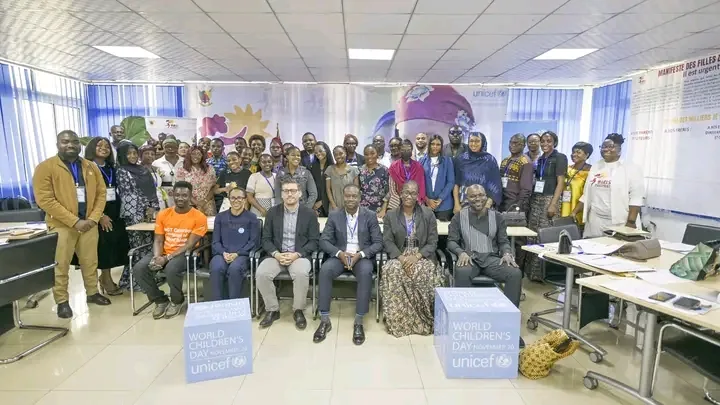
A group of institutional and civil society actors committed on May 21, 2026, to transforming the Cameroon girls’ manifesto into an operational roadmap by October 2026. A decisive step to prevent this founding text from remaining dead letter.
On November 28 last year, during the National Girls’ Forum, a rare voice emerged strongly. Cameroonian teenage girls put on paper a straightforward manifesto: they did not ask for promises, but measurable commitments in education, empowerment, and protection.
Since then, one question dominates institutional circles: how to prevent this text, carrying concrete aspirations, from disappearing into administrative oblivion?
This is the whole challenge of the workshop organized on May 21, 2026, under the impetus of UNICEF and the ministry in charge of the promotion of women and family, alongside civil society organizations. The objective is clear: to translate the manifesto into a structured action agenda, anchored in local realities.
For the participants, the time for formulating intentions is over. “The urgency is real,” insisted Paul-Marie Petro, recalling that the needs expressed by the girls must now find concrete and verifiable responses.
Three axes structure the work: continuous advocacy, rigorous monitoring of public commitments, and independent evaluation of adopted measures. Civil society organizations thus position themselves as watchdogs and drivers of accountability.
At the end of the discussions, an institutional advance is emerging: three representatives of civil society now join the Task Force dedicated to the Girls’ Agenda. A hybrid configuration, designed to maintain pressure and guarantee the effective implementation of decisions.
The girls’ manifesto is therefore no longer just a document. It becomes a political test: that of the institutions’ ability to transform a citizen voice into sustainable public action.
Read more Team analysis and prediction for the Fulham vs Newcastle match