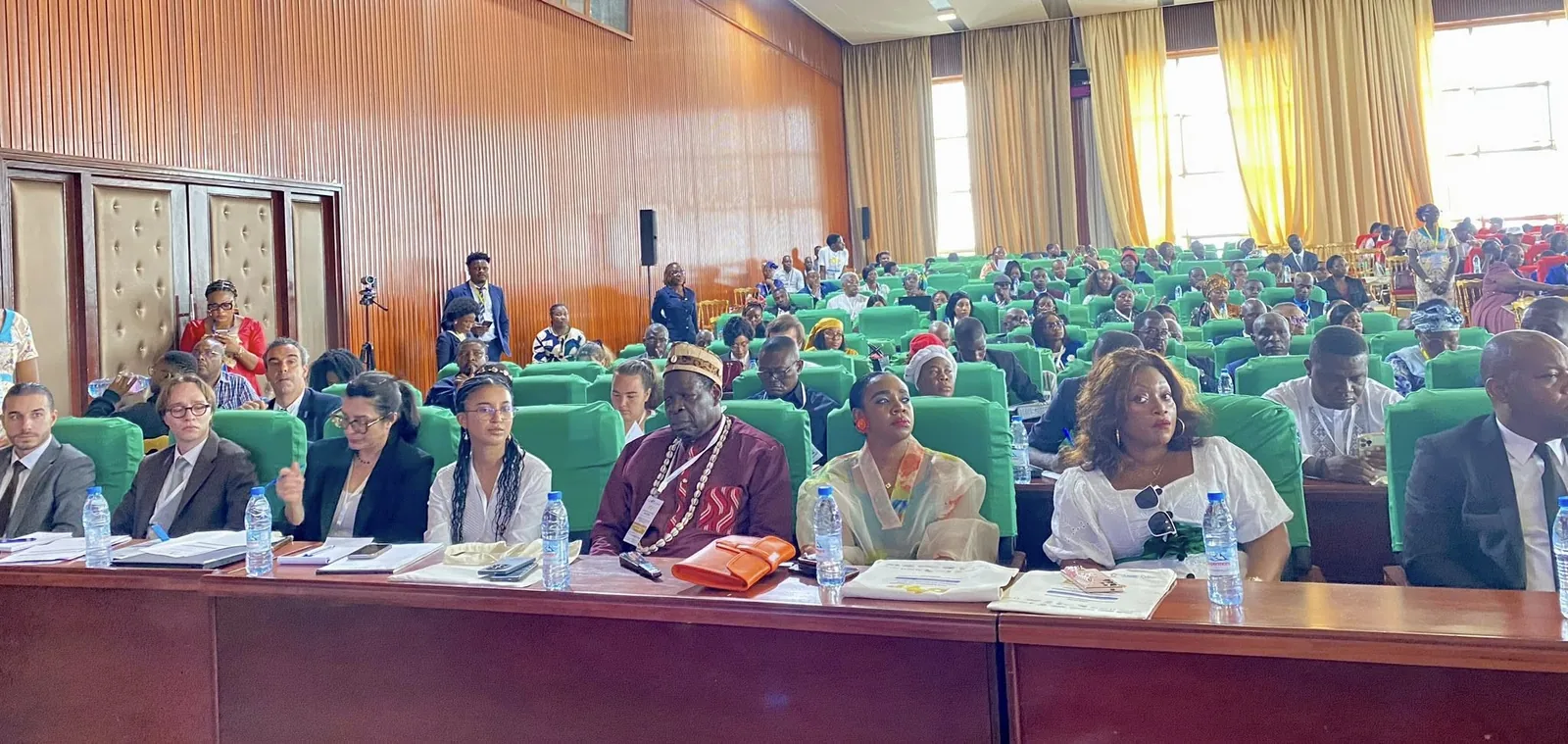
At the initiative of the International Council for Dialogue and Partnership (CIDP), the Yaoundé Conference Center hosts the first edition of the Permanent African Dialogue (DAP). Public actors and youth intend to rethink migration on the continent.
Under the theme “Youth and migrations: structuring and sustainably financing African youth systems,” the Permanent African Dialogue (DAP) aims to be a permanent framework to transform mobility. The various speeches delivered on the occasion revolve around the search for concrete solutions so that mobility becomes an opportunity and African youth move from being a vulnerable group to an “active decision-maker” of the continent’s destiny. “Mobility is normal in life activities but when it becomes inevitable, it is dangerous,” said Prof. Jean Emmanuel Pondi in his inaugural lecture at the opening of the proceedings on April 28, 2026.
Read more The EU and civil society improve detention conditions for 6,000 inmates in Cameroon
The initiators of this dialogue explain that it calls for a paradigm shift to rethink the migration issue from Africa itself, placing the structuring and mobilization of funding dedicated to youth at the heart of the system. “It is no longer about addressing the migration issue through the prism of youth flows to be contained, but about organizing it, considering it as an economic and human dynamic capable of channeling talents, creating value, and building sustainable trajectories for the continent.“
The goal of this first Permanent African Dialogue, explains Dr. Hemes NKWA, CIDP Coordinator, is to transform youth, often idle or unheard, into a central actor of development in Cameroon and Africa. To avoid it being just another conference, she presents a strategy based on three levers.
A real co-construction, the event brings together youth, government officials, private sector actors, and diplomats around the same table. During the proceedings, these stakeholders jointly define solutions related to skills, financing, and the market. The idea, says Dr. Hemes NKWA, is: “Staying in the country, a choice for fulfillment, and leaving, a voluntary option, not an escape due to lack of opportunities.” The second lever is the adoption of the Yaoundé Declaration, led by the youth themselves. This does not add to existing texts but organizes them to finally make them operational. And finally, rigorous and international monitoring. The coordinator assures that emphasis will be placed on accountability and a concrete roadmap so that speeches are translated into action.
Read more Maroua: FEICOM strengthens its support for structuring projects in the Far North
Changing the narrative: youth, a driving force and not a “problem”
Present at the launch ceremony, the Head of Mission of the International Organization for Migration (IOM) in Cameroon, Abdel Rahmane Diop, welcomes Cameroon’s decision to develop a national policy to manage migrations. “We cannot imagine such a policy without the voice of youth. We cannot imagine such a systemic construction without the main stakeholders being heard.” He recalls that Africa is experiencing an unprecedented demographic reality: “60% of its population is under 25 years old.” For him, the challenge is no longer to associate youth with decisions as a principle, but to place them at the heart of the “co-definition of public policies.” Abdel Rahmane Diop states that youth are not a “problem to be solved,” but an essential driving force for the economy and innovation. The head of the IOM invites various actors to change the narrative. He explains that migration is not an anomaly or a crisis, but a human and historical reality linked to everyone’s aspirations. He calls to transform migration into a safe and dignified choice, rather than a risk by default. To achieve this, it is crucial to use language that respects the dignity of migrants and avoids stigmatization.
For his part, the representative of the Minister of Youth and Civic Education assured that youth issues in general and issues related to youth migration in particular are at the heart of the political concerns of the Head of State and are central to national public policies regarding youth integration. The search for endogenous, sustainable, and satisfactory solutions for youth is a very important concern.
These responses reinforce the IOM representative who insisted on the need to harmonize policies between global agendas (UN) and African agendas (Agenda 2063). This includes financing youth systems, recognizing migrants’ skills, and the successful reintegration of returning migrants. This approach is supported by key partners such as the European Union, the African Union, and the IOM.
Read more Trade bills declining, checking accounts rising: the paradox of payments in CEMAC