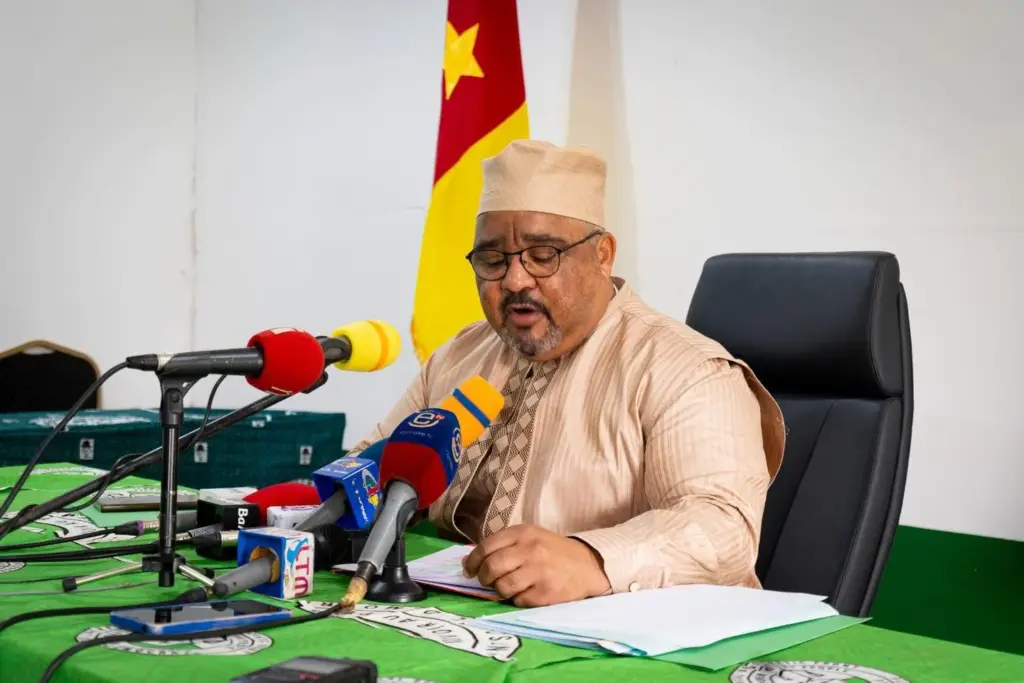
During a press conference held in Yaoundé on July 23, 2026, the national president of the Social Democratic Front, Joshua Osih, raised his voice to strongly denounce the management of the state as carried out by the RDPC regime.
Three points drew attention in the introductory remarks of the chairman of the Social Democratic Front delivered during the press conference. These were, in this instance, the governance of Cameroon, the successive postponement of elections, as well as the management of the security crisis in the North-West and South-West regions. Indeed, Joshua Osih denounced the remote governance of the Republic of Cameroon as well as the lack of transparency in resource management.
Read more Wood processing: Cameroon focuses on four industrial hubs to create more value
For six weeks, the Head of State has been outside Cameroonian territory without “any image, any address, any announced return.” And the vice-presidency “hastily created in the name of state continuity remains vacant. Cameroon is a Republic on autopilot,” the politician declared.
According to him, many of the sufferings of Cameroonians are a consequence of these governance-related shortcomings. These are also visible through the inefficiency in responding to social problems, the lack of transparency in the management of resources such as oil, tax, and mining revenues. “We are able to say that the tax, oil, and mining revenues are not accurate. The SDF demands the true figures of state revenues,” he stated, indicating that the government can solve the problems of Cameroonians through simple governance work.
A tailor-made democracy
In addition to governance problems, the SDF protested against attacks on democracy in the country. The reintroduction of the vice-presidency in Cameroon, excluding its designation by popular vote, is one illustration of this. While the party itself proposed an amendment for the vice-president to be elected at the same time as the president, with one being from former French Cameroon and the other from former English Cameroon, the ruling party opted for appointment.
Read more Electricity: Hydro-Mekin prepares the rehabilitation of its 15 MW plant on the Dja River
In this order of rejections, the party also submitted five bills that were not accepted by the conference of presidents of the National Assembly. The party also protested against the successive postponement of legislative and municipal elections and urged the authorities to respect the deadlines expected in 2027. “Do not touch the election date again. Any attempt to further postpone these elections under any pretext whatsoever: security, calendar, finance, consensus, will be treated by our party as an unconstitutional confiscation of the people’s mandate,” warned the chairman.
No to getting used to the Anglophone crisis
Furthermore, the president of the balance party expressed his political party’s concern about the persistence of the Anglophone crisis, which has lasted for 10 years. According to him, 6,000 Cameroonians have been killed in this conflict. It has led to approximately 648,000 internally displaced persons, with cumulative displaced persons approaching 900,000 people. 80,000 people are refugees in Nigeria. 600,000 children are deprived of schooling. 2,000 people are in prison in connection with this crisis. Approximately 2 million people need humanitarian assistance. Still according to him, the South-West has lost its cocoa and industrial leadership. Exports and investments are declining while growth is lost year after year. However, on the eve of the 2025 presidential election, the SDF made proposals for a way out of the crisis.
Read more APN-IRIC: a strategic partnership to strengthen port governance