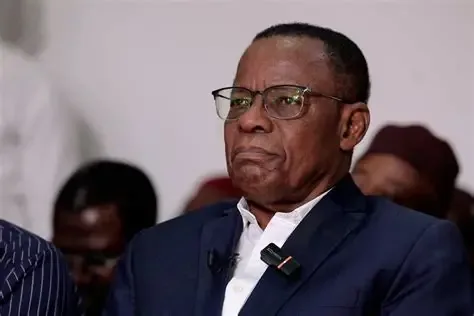
The president of the Movement for the Renaissance of Cameroon accuses the regime of having violated the Constitution in the process that led to the extension of the mandate of local elected officials.
Maurice Kamto challenges the latest extension of the mandate of municipal councilors that took place in Cameroon following the decree of the President of the Republic on May 4, 2026. The president of the MRC announces the referral to the Constitutional Council for violation of the Constitution. He bases this on a certain “encroachment of the executive power on the domain of the law, which belongs to the parliament,” as well as on the violation of democratic principles.
Read more Cameroon launches the 6th edition of Childhood Month
In fact, the president of the MRC does not accept the legality of the procedures and acts that led to lifting the restriction on extensions contained in the former article 170 of the electoral code. This was modified by the adoption and promulgation of a recent law giving the head of state the power to extend the mandate of municipal councilors beyond the 18-month limit as provided by the law. However, this law of April 14, 2026 “contains no article stating the retroactive effect of its provisions.”
Consequently, whereas under the old legal provision the mandate was to end no later than August 9, 2026, it was extended until February 27, 2026. According to the opposition figure, the presidential decree imposing this extension “manifestly violated the principle of non-retroactivity enshrined by the Constitution in its preamble,” a principle which means that the law should only have effect in the future and not for acts prior to its promulgation.
Relying on these legal provisions and democratic principles, the law professor is categorical. “As of June 1, 2026, municipal councils are in a state of legal vacancy throughout the national territory… The heads of municipal executives must acknowledge this vacancy and take all legal consequences for themselves and for the communities they represented,” he warns.
The opposition figure believes that the new legal framework causes dysfunction in institutions. He refers the matter to the Constitutional Council to order the head of state to convene the electorate for municipal elections. One wonders whether such a referral can produce the expected effect before a Constitutional Council that most of the time declares itself incompetent or declares the requests inadmissible.