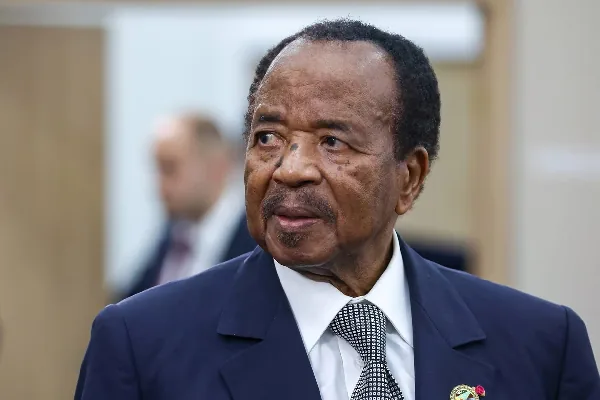
Political news in Cameroon is marked by the creation of a Vice-President post by parliamentarians (deputies and senators) meeting in congress at the request of the President of the Republic. The creation of this post, the possibility of which some observers and actors on the Cameroonian political scene were already mentioning, comes a few days after the extension of the mandate of deputies and municipal councilors. Since then, several questions have piqued curiosity.
Read more FECAFOOT and Red Cross: an alliance serving the health of footballers
Why the creation of a Vice-President post? Why now? Why after the extension of the deputies’ mandate? Did the parliamentarians who proceeded with its creation have legitimacy when we know that in the case of the deputies, their mandate was extended at the request of the President of the Republic? What will the post of Vice-President be used for in a unitary state where bicephalism already exists within the executive power, that is to say, a power embodied by the President of the Republic and the Prime Minister? Are we going to witness tricephalism within the executive power or are we moving towards a new abolition of the post of Prime Minister as was done in 1984 before being created again in 1991? What will be its powers? Who will be appointed to this post? What will be their identity (Anglophone or Francophone)?
All these questions are relevant, but our interest in this article is to show that President Biya is preparing the way for his successor, much like Ahidjo did in his case.
To this end, let us begin by saying that the law has never been the expression of the general will as a certain legal dogmatism claims. It is the expression of the balance of power or the will of the dominant minority. In Africa, especially Francophone Black Africa, the law is nothing more than an instrument in the hands of the ruling minority. It is an instrument for legitimizing the confiscation of power, the privatization of national resources, the systematic violation of consciences, and finally “Janusian democratization,” to use the words of Mathias Éric Owona Nguini and Hélène Laure Menthong. In the political game, the law has often served as an instrument for the ruling elite to control this game, to justify political arrests, to muzzle (erasing or limiting fundamental freedoms), to intimidate, and finally to guarantee the everlasting management of power.
In this line of thought, we can better understand the creation of the Vice-President post. Its creation does not, therefore, stem from the will of the people expressed by parliamentarians, especially since the mandate of some of them (the deputies) had already come to an end. The postponement of the legislative and municipal elections, which led to the extension of the deputies’ mandate, is part of a political strategy aimed at controlling the political field alone (the ruling party) and ad vitam aeternam. Aware of the mixed results of the last presidential election, an election marred by serious electoral fraud and contested results, Paul Biya could not risk organizing the double legislative and municipal ballot. The fear of seeing victory escape them or losing the majority in the National Assembly with the subsequent effects (appointment of an opposition Prime Minister and composition of the government with several members of the opposition, modification of certain laws that could go as far as reforming the electoral code, etc.) are at the origin of this postponement.
It must be said that unlike the presidential election, which uses the single-member ballot marked by a synergy of energies and a consensus around the candidate, the national president of the party (Cameroon People’s Democratic Movement), the legislative and municipal elections use the list system characterized by sharp internal rivalries, conflicts over political positioning, quarrels, and challenges to the nominated lists. This meant that the leaders of the ruling party could not organize this double ballot, especially since the phenomenon of political transhumance observed during the last presidential election and the protest vote were still fresh in memories and could not benefit from better control as in the presidential election, a single-member ballot. The least President Biya could do was to postpone this double ballot, especially since the wound of the post-election crisis (Presidential 2025) is still gaping. Through this maneuver, he could therefore launch his Vice-Presidency project with the deputies whose mandate had already expired, through a parliament essentially composed of militants of the ruling party, the CPDM.
What President Biya and his party are doing is what Maurice Kamto calls the “Constitutional Successor.” We are returning to the configuration that brought Paul Biya to power in 1984, a configuration marked by what Fabien Nkot calls “the political use of law.” A brief reminder of the facts concerning this case. The constitutional revision of June 2, 1972, moved Cameroon from a federal state to a unitary state, abolishing the post of Vice-President that the Constitution of September 1, 1961, had created, with John Ngu Foncha holding the post alongside the President of the Federal Republic of Cameroon, Ahmadou Ahidjo, according to the agreements of the two parties. It should be remembered that this 1961 Constitution established, according to the agreements of the two parties (East or French Cameroon and Southern Cameroons, one of the two provinces of the British Cameroonian part).
In 1975, a constitutional revision created the post of Prime Minister and Paul Biya was appointed to this post. In 1979, another constitutional revision was made with the major reform being the management of the power vacancy. In fact, this revision made the Prime Minister the successor to the President of the Republic in the event of a power vacancy. The way was thus prepared for Paul Biya, the French choice, to come to the head of our country, also ensuring the Francophonization of power or the continuity of power management by a Francophone. Moreover, President Ahidjo’s resignation on November 4, 1984, was only a continuation of these maneuvers aimed at bringing Paul Biya to the head of our country two days later (November 6, 1984).
In short, the post of vice-president that has been created confirms the “mutual agreement” (gré à gré) that some political actors spoke of before its advent. It is similar to the post of Prime Minister when it was created in 1975 and led to play the role of constitutional successor in 1979. It is a post that initially proved to be budget-consuming and subsequently a means of institutional conservation of power. Its creation marks the end of the Biya era and the upcoming advent of the one he will have chosen in agreement with France as his successor. The first signs of this successor’s identity will be known with the Pope’s upcoming visit to Cameroon. Is it an Anglophone or a Francophone for the continuity of power management by a Francophone? One thing is certain: if this post once again goes to Francophones, it will contribute to amplifying the conflicts in the North-West and South-West.
Read more 2026 budget execution: MINEDUB focuses on performance and transparency
Séverin Hyacinthe BATSOK, researcher-lecturer