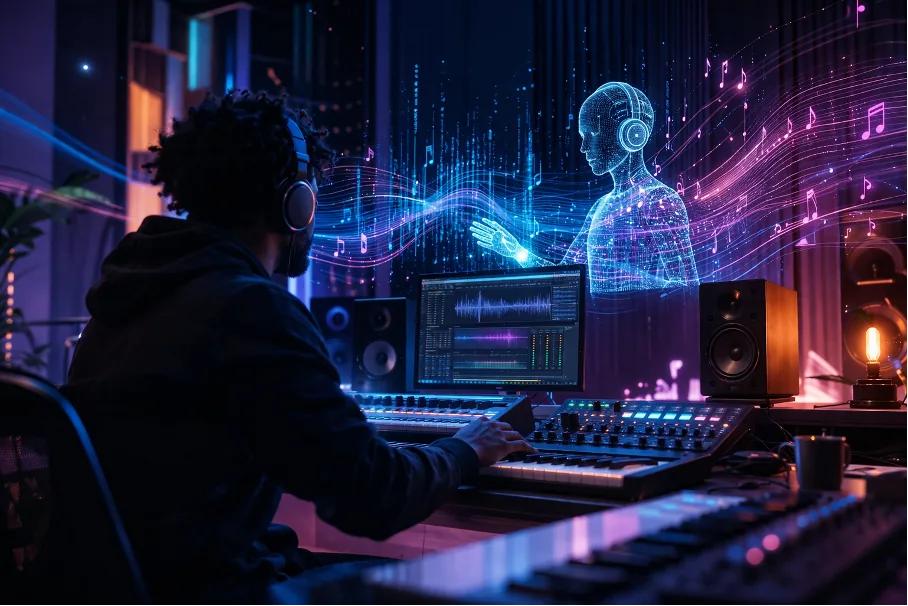
Saying that AI is “invading” the charts is an oversimplification. It is already there, but not necessarily where the public thinks. It is not virtual artists dominating the rankings. It is invisible tools influencing production, distribution, and virality.
Read more Douala: the exhortation of Pope Leo XIV to the youth
Today, a large part of popular tracks go through AI-assisted processes: automated mastering, structure suggestions, optimization for streaming platforms. This is not marginal. It has become standard.
Within this ecosystem, some platforms analyze digital trends and audience behavior with increased precision. Relying on tracking and performance analysis tools, https://1mlnbet.com/ allows better understanding of how certain content manages to climb the charts.
The real change is not creative
Contrary to what one might imagine, AI does not yet replace artists in the global top charts. Hits remain mostly human. The change is elsewhere. It lies in the speed and precision of production.
Today, a track can be:
- analyzed based on current trends;
- adjusted to match high-performing formats;
- optimized to capture attention from the first seconds;
- calibrated for recommendation algorithms.
Result: less chance, more calculation. And this is where perception becomes false. We think we see more creativity. In reality, we see more optimization.
A standardization that does not say its name
The more accessible the tools become, the more productions resemble each other. Same length, same structures, same dynamics.
Read more Cameroon: Mamadou Mota denounces the influence of politics and money on the Christian faith
This is not a coincidence. Platforms favor certain formats. AI identifies them, then reproduces them on a large scale.
This phenomenon creates a loop: data influences creation – creation confirms data. And in this cycle, originality becomes a risk.
Threat or simple logical evolution?
AI does not destroy the music industry. It makes it more predictable. For independent artists, it is a real opportunity. Access to powerful tools, cost reduction, faster production.
But for the audience, the risk is different: less surprise. When everything is optimized, nothing really stands out. And maybe that is where the real break will appear – not in technology, but in those who choose not to use it.
Read more Cameroon: Pope Leo XIV strengthens interreligious and social dialogue